Cooney Coil & Energy logo
Heat Exchangers 101: What Facility Managers Should Know

Heat Exchangers 101: What Facility Managers Should Know

Heat exchangers are an essential component in facilities and systems that require the transfer of heat from one medium to another. In most cases, that means transferring heat from a hot medium (such as steam) to a cold fluid (like water).

But how does it work? And more importantly, which type of heat exchanger is best suited for your facility? Let’s break down some of the basics.

Types of Heat Exchangers

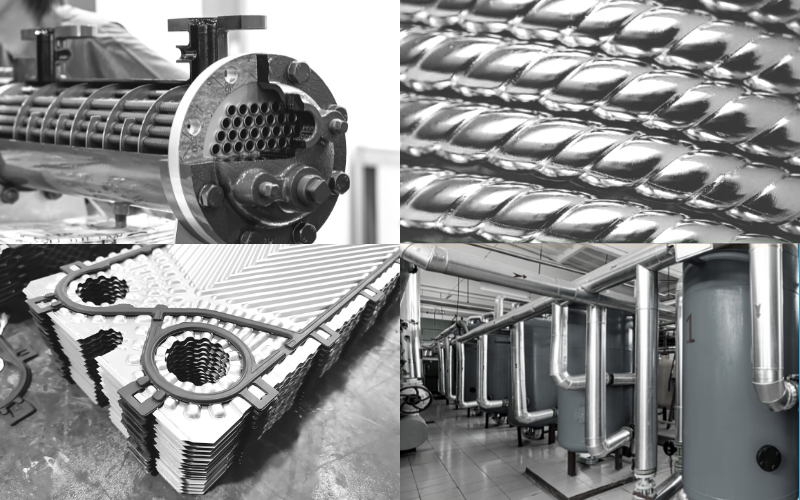
Heat exchangers come in many shapes and sizes, each designed to handle different levels of pressure, temperature, and flow rate There are four main types of heat exchangers: Hot Water Storage Tanks with Steam or Hot Water Immersion bundles, Plate & Frame, Shell & Tube, and Shell & Coil. Let’s take a look at the key differences between these types of heat exchangers:

Hot Water Generator Storage Tanks with Steam or Hot Water Immersion Bundles

These hot water generator / storage tanks have been popular with facilities for many, many years. They have been typically used for generating domestic hot water for the facility using either a steam immersion bundle or 180F heating hot water bundle in a large vertical or horizontal storage tank. Circulation pumps are used to assist in the recovery rate of the hot water and also maintaining the proper hot water set temperature throughout the system. They provide a large buffer amount of available hot water.

These storage tanks take up a large footprint and energy efficiency suffers by keeping the large volume of water (1500 gallons or more) at the desired temperature even at times of minimal actual usage. Unheated, stratified potable water in this system may be susceptible to Legionella concerns, especially in healthcare facilities. Leaking immersion bundles require rapid attention to prevent possible water contamination or flooded condensate systems.

Plate and Frame Heat Exchangers
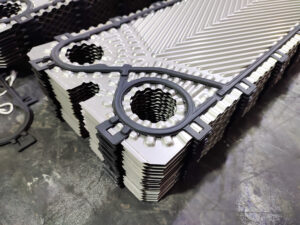
Plate and frame heat exchangers are a common type of heat exchanger used in industrial applications. This type of heat exchanger consists of several metal plates sandwiched together with gaskets between each plate. The plates create separate channels for each fluid to flow through; as one fluid passes over the plates it absorbs the heat from the other fluid. Plate and frame heat exchangers can be used for both heating and cooling processes for facilities that need to maintain steady temperatures year-round. Be careful using these with steam applications as the gaskets often get worn out due to the high temperatures and can cause leaking. If used with improperly filtered water, the tight fluid pathways in the plates may clog and decrease heat transfer dramatically.


Shell & Tube Heat Exchangers
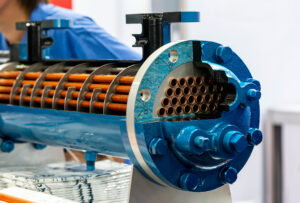
Shell and tube heat exchangers are another type of commonly used industrial and commercial grade heat exchanger. These consist of a tube bundle contained within an outer shell; one fluid flows through the tubes while another medium (typically steam) flows around them in the shell space.

Shell and tube heat exchangers are fairly efficient; they can handle large volumes of both hot and cold fluids simultaneously while providing very good temperature control. This makes them ideal for applications where precise temperature control is needed. A disadvantage to shell & tube heat exchangers is their large footprint which can make maintenance difficult if repairs are needed to the tube bundle. Other concerns may be, pull space for bundle replacement and flash steam in the condensate system.

Shell & Coil Heat Exchangers
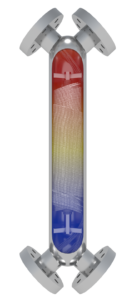
Shell & coil heat exchangers are similar to shell & tube units but with several distinct advantages — they offer more compact designs, improved portability, higher levels of thermal efficiency, faster response times, lower pressure drops across the unit, quieter operation, easier maintenance access, and increased durability due to fewer components than traditional designs have.

While fully-welded stainless steel shell & coil units may not be as widely used as hot water generator or storage tanks, plate & frame or shell & tube units yet, these advantages make them well worth considering if you need a reliable yet highly efficient source of thermal energy transfer in your facility.

 Heat exchange is an important part of any facility manager’s job because it can help increase efficiency while lowering costs associated with energy usage. These four main types of heat exchangers each offer their own unique set of advantages depending on your application needs. By understanding which type best suits your needs, you can ensure that you get maximum performance out of your thermal energy transfer equipment while reducing operational costs over time.   It pays to do some research on which type would work best in your situation so you can maximize its potential benefits for your facility’s operations!

Need help selecting a heat exchanger? Give our team a call today at (610) 783-1136!

Looking for a New Heat Exchanger?

At Cooney Coil & Energy, we offer a variety of heat exchangers for all types of applications.

Unsure of what you need? Give our team a call at (610) 783-1136 to schedule a site visit and consultation today.
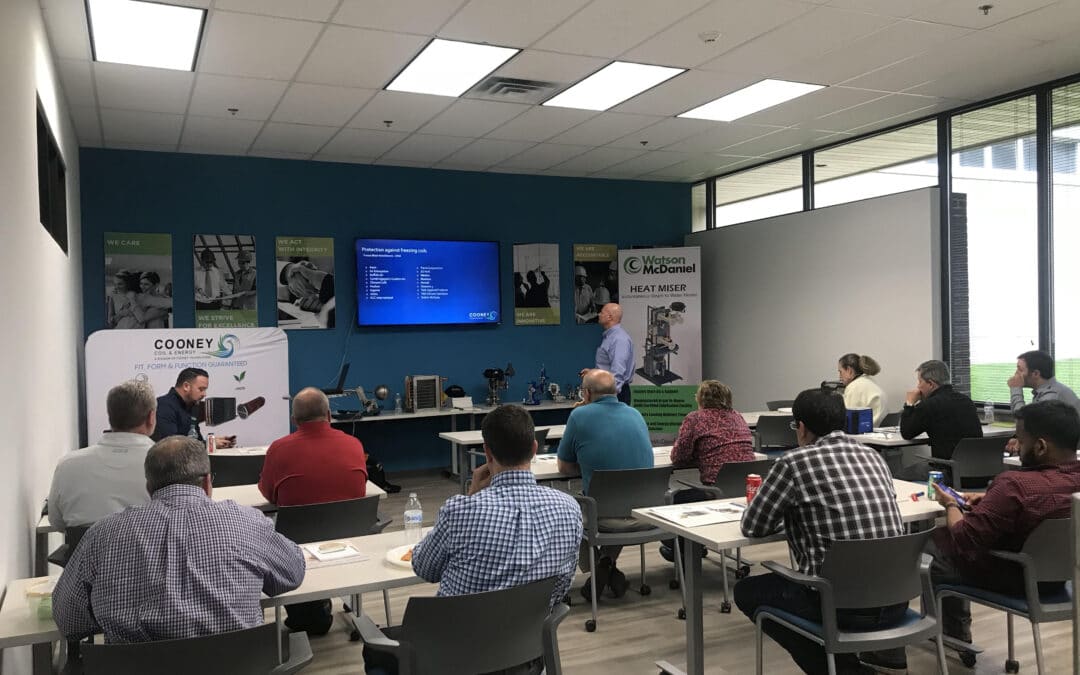

Mark Your Calendar For the Next Lunch and Learn!

Mark Your Calendar For the Next Lunch and Learn!

Join Us for a Lunch and Learn and See What We Can Do for You!

We talk a lot about HVAC replacement parts and products. After all, it’s what we do. This company was built on a foundation of experience that Bob Cooney gained in the HVAC repair and replacement field, and it’s still the core of what we do. But Cooney Coil & Energy is much more than just another manufactures rep firm in the HVAC industry.

Cooney Coil & Energy has always been dedicated to our customers first. That is a commitment we take seriously. That’s why we hold special community education events called Lunch and Learns. We want to be known for more than our HVAC replacement parts expertise and incredible Freeze Block™ Technology. We want to educate our customers and the community in the world of heating and cooling systems.

Why a Lunch and Learn is a Great Use of Your Lunch Break

We, of all people, understand that a lunch break is a precious resource! That’s why we want to offer our services to make yours worthwhile. At the Cooney Technologies Lunch and Learn, you will experience:

Lunch & Learn Commercial HVAC

  • Lunch on us! The most important part of every lunch break is the meal itself. First and foremost, our lunches are social events. Come enjoy delicious food and mingle with industry professionals. It’s on us.
  • Discussion of HVAC basics and innovations! The world of heating and cooling systems can be confusing and overwhelming, so we’re here to simplify it. Join us to learn about HVAC basics, what makes the technology work, and some advanced information about getting the most out of your system. The round-table style of discussion allows us to directly address any concerns and questions you might have.
  • Discussion of Freeze Block! No one knows the proprietary Freeze Block technology like the guys who invented it! Learn about options for preventing your coils from freezing and rupturing due to freezing. We can help you determine if Freeze Block technology might have a place in your system, or if your money might be better spent on other solutions.
  • Requested topics! If you get in touch and let us know what you’d like to talk about for Lunch and Learn topics, we can put together a Lunch and Learn presentation for you to answer your questions! The more prepared we are for your team, the better we can help.

Get on the Lunch and Learn calendar and look forward to a lunch break worth taking. Let us come by and answer any questions you have about HVAC systems. We’d love to get to know you better plus, lunch is on us! Give us a call today at 610-783-1136 to get started!

Cooney Coil & Energy Now Offering Microchannel Replacement Coils!

Cooney Coil & Energy Now Offering Microchannel Replacement Coils!

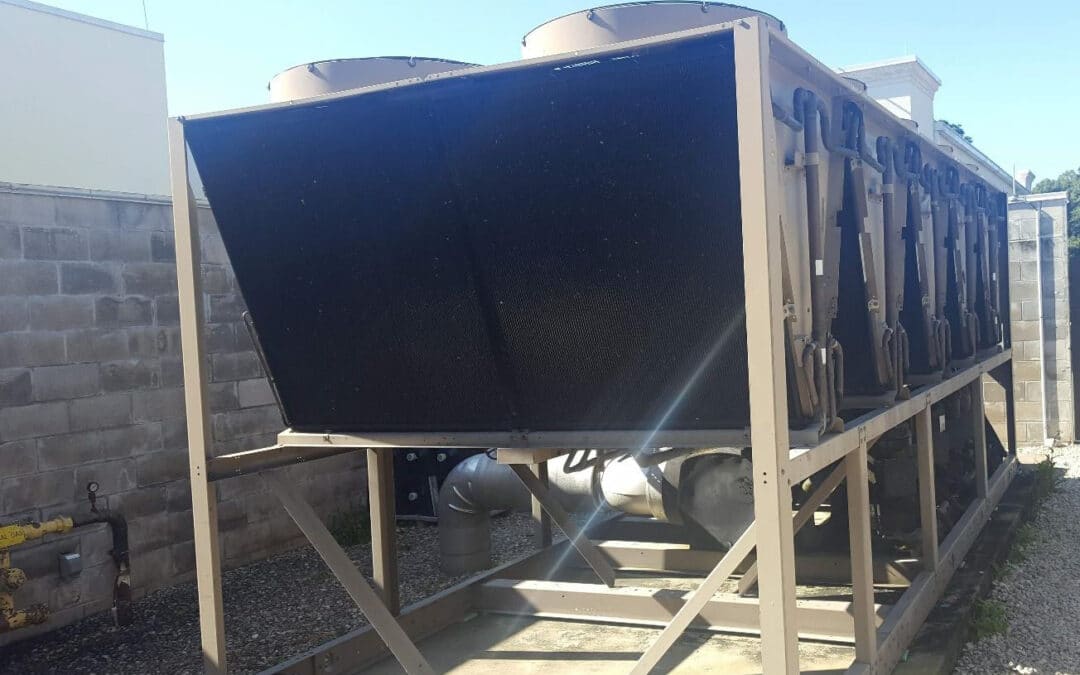
We’re happy to announce our Cooney Coil & Energy division now an Evapco Alcoil distributor of MicroChannel coils!

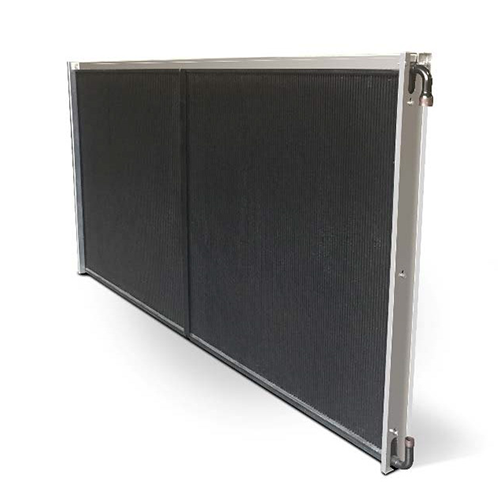
Evapco’s microchannel coils are a robust design and built to last longer than typical OEM microchannel coils. Contact us today for replacement microchannel coils in the Philadelphia area.

Stock and Custom Coils Available

Why do Coils Fail?

Coils fail for a number of reasons.

These include:

// Vibration // Corrosion

// Excessive fan cycling

// Low load cycling // Physical damage

Fin/Tube coils are naturally susceptible to galvanic copper to aluminum corrosion that significantly reduces fin performance over time, and can also sacrifice the aluminum fin material in seacoast environments. Copper elbows and tubes also can corrode, pit, and crack over time. Thus, a coil mean time to failure can range from 5-10yrs, and preferably 15-20 years or more, if robust.

Microchannel coils, manufactured by others can fail due to the same reasons listed above. In many OEM systems, these coils are automotive style and use thin tube walls, yet are susceptible to the worst of operating conditions, vibration, and sea coast effects. Microchannel coils are the future of chiller condenser coils, but must take the same abuse, wear and tear.

Why Evapco Alcoil?

Evapco Alcoil is an all-aluminum microchannel coil, designed for high efficiency, with fins integrally brazed to the tubes, and tubes integrally brazed to the headers. Evapco Alcoil, however, is a robust industrial constructed coil with thicker tubes and thicker headers. It is the latest generation of high-performance condenser coil with vertical tubes (not horizontal) to reduce standing water on the coil, reduce thermal stresses and provide features intended for longer life operation.

How is a Evapco MicroChannel Replacement Coil Different from an OEM MicroChannel Coil?


// Non-Automotive, industrial design

// 25-30% Thicker tube walls

// Epoxy Coating for superior corrosion protection

// Lower Refrigerant Pressure drop for improved operation and oil return

// Built-in Mini-receiver (in lower header) to make it easier to charge

// Side Flange for drop in/slide in installation

// 5-Year Warranty

Contact Us Today!

Make sure your microchannel coils are ready for cooling season. Contact us for a free site visit.

Benefits of UVC Light for Commercial HVAC Systems

Benefits of UVC Light for Commercial HVAC Systems

What is UV Light?

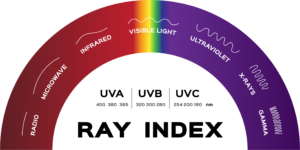
Ultraviolet light, also known as UV light, is a part of the electromagnetic spectrum. There are several types of UV frequencies.
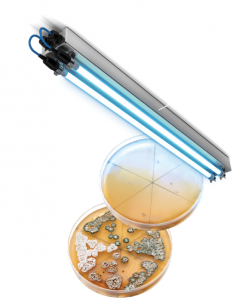
UVA and UVB frequencies are present in sunlight. These are the frequencies that cause sunburn.

UV-C light is a higher frequency light. The ozone blocks UVC light, so it is weak at the Earth’s surface. Ultraviolet germicidal irradiation, or UVGI, is a method that kills microorganisms using UVC light.

How Does UVC Light Work?

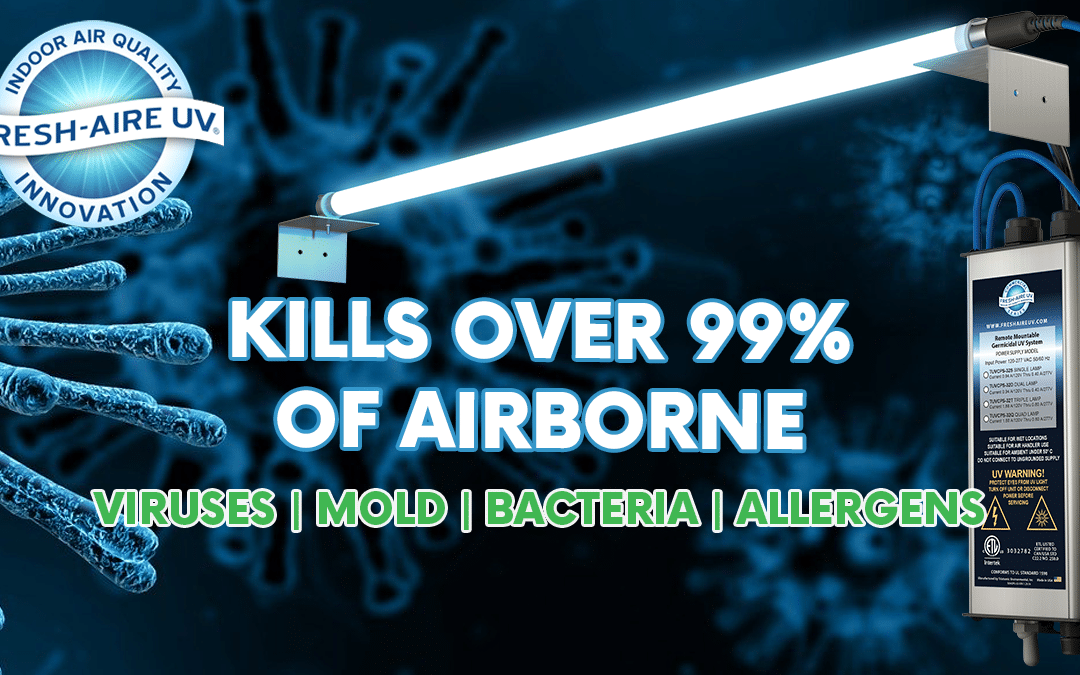
Photons emitted from the bulbs of the UVC Lights penetrate the cells of microbes, and altar organisms so they’re unable to reproduce. When applied and proper dosages, ultraviolet irradiation effectively kills viruses, bacteria, mold, allergens.

As a general rule of thumb, surface disinfection requires less intensity because you are irradiating a fixed surface.

Air disinfection requires a higher intensity per square foot because the air is moving much faster. It is important to have an expert measure your system for proper dosage and disinfection.

Benefits of Using UVC in HVAC Systems

//  Improved Indoor Air Quality & Building Health

There are many benefits to using UVC lights in your HVAC system. Properly sized lights can eliminate viruses, mold, bacteria, and other contaminants, turning your HVAC system into a disinfection machine. 

// Increase HVAC Efficiency

Without UVC lights in place, coils can become clogged and insulated with a matrix of dirt, bacteria, mold, and viruses called biofilm. A biofilm of only .002″ can reduce efficiency by 37%. So, your equipment has to work harder, wasting energy and hurting your bottom line. UVC lights reduce this microbial growth, increasing system efficiency.

// Reduce Maintenance

UVC lights can reduce your maintenance costs by keeping your HVAC coils clean eliminating the need for routine coil cleaning.  Case studies show that coils treated with UVGI had an increased pressure drop compared to coils that were manually cleaned. Chemically cleaned coils may appear to clean, but may actually be a hotbed for microbial growth.

Coils are Interested to learn more? Check out our mini-webinar on using UVC lights for health and system performance.

How Much Does it Cost to Install UV Lights in HVAC Systems?Fresh Aire UV Distributor

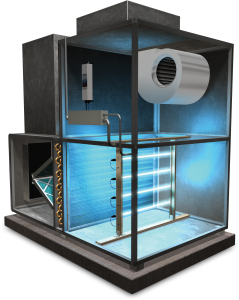
UV light can be installed in air handling units, ducts, fan coils, and even be used for in-room disinfection. Because the lights eliminate and prevent microbial growth on coils, the system runs more efficiently. These energy savings can result in a payback period of about a year.

Since all projects are unique, the cost and system needed can vary. Complete the form below and receive a quote for UVC lights in your HVAC system today!

Infectious Disease Mitigation Analysis

Interested in seeing how HVAC infectious disease control strategies stack up? Use our infectious disease calculator to evaluate: efficacy, upfront cost, and cost over time.

UV-C Light for a Cleaner HVAC System

UV-C Light for a Cleaner HVAC System

Call us at 610-783-1136 or email [email protected] to ask about our free UV light trial!

I have Fresh-Aire UV lights installed in my facility. Do UV lights kill coronavirus?

UV-C is has been tested and proven to achieve up to 99.999996% reduction of microorganisms, including viruses. While Fresh-Aire UV systems have not been specifically tested against coronavirus, they have been tested and proven effective against similar pathogens, some which require an even greater dosage for inactivation than coronavirus.

What is UV-C Light?

UV-C is the frequency used in germicidal UV lights. UV-C light technology can be used in AHUs, ducts, ice machines, and in-room disinfection. UV-C lights help sterilize microbial growth, reduce maintenance & energy costs, kill airborne germs, improve indoor air quality and disinfect chemical-free.

Do UV-C lights kill airborne germs?

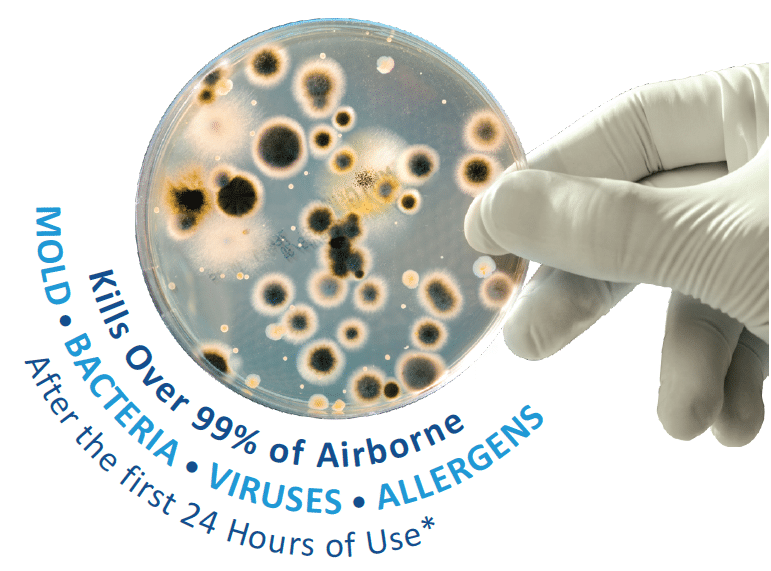
UV-C light disrupts viruses, bacteria, mold and allergen’s DNA which prevents them from reproducing, effectively killing them. Our Airborne Disinfection System is equipped with high-output UV-C lamps to kill airborne pathogens 24/7. Learn more about how UVGI technology can help fight infectious diseases here.

Do UV-C lights kill germs on the surface of the coil?

The environment of an air handler is the perfect breeding ground for bacteria. A biofilm of only .002″ can reduce efficiency by 37%! UV-C light kills 99.9% of microbial growth on coils and sterilizes coils continuously 24/7 365.

Is this technology validated?

Yes, UV-C is a well-established technology that is recognized by the CDC, ASHRAE, and GSA.


Infectious Disease Mitigation Analysis

Interested in seeing how HVAC infectious disease control strategies stack up? Use our infectious disease calculator to evaluate: efficacy, upfront cost, and cost over time.